

Natural Pain Relief In Labour: 10 Ways To Work With Contractions
- Donna

- 15 hours ago
- 5 min read

If you're wondering how you'll cope with labour pain, you're not alone. It's one of the most common questions first-time parents ask.
The good news is that there are many natural ways to make contractions feel more manageable. None of these techniques are about having a "perfect" birth or avoiding medical pain relief. Instead, they help you work with your body during labour, stay as relaxed as possible, and give you more options as labour progresses.
Many women use a combination of natural techniques alongside gas (Entonox), an epidural or other medical pain relief. The best approach is the one that works for you.
1. Keep Moving
One of the simplest and most effective ways to cope with contractions is to keep moving.
During labour, many women naturally find themselves swaying, walking, rocking or leaning forwards. These movements often feel instinctive because they can help relieve discomfort while encouraging your baby to move down through the pelvis.
Movement may also:
Reduce back pain.
Help your baby find a favourable position.
Encourage labour to progress.
Give you something active to focus on during contractions.
There's no single "right" position in labour. Changing positions regularly and listening to your body is usually the best approach.
2. Let Gravity Help
Staying upright allows gravity to assist your baby's descent.
Depending on how you're feeling, you might find these positions comfortable:
Standing while leaning on your partner.
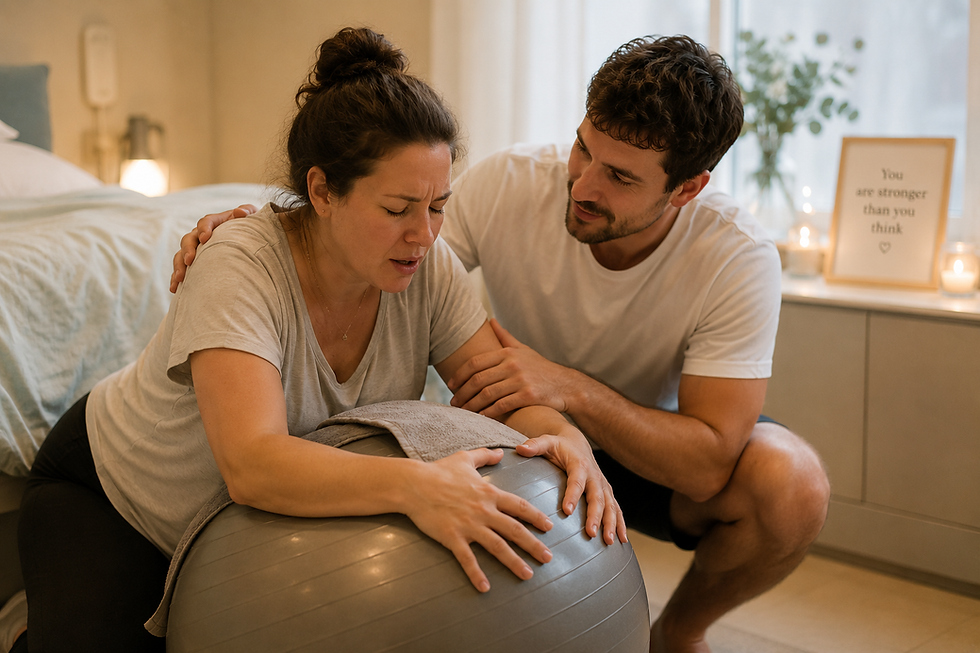
Kneeling over a birth ball.
Sitting on a birth ball.
Hands and knees.
Supported squats.
Leaning over the bed or a chair.
Even small position changes can make a noticeable difference during labour.
3. Use Your Breathing To Stay Relaxed
Breathing techniques don't remove labour pain, but they can help prevent your body becoming tense.
When we're anxious, we often hold our breath and tighten our muscles. Relaxed breathing helps reduce that tension and encourages you to stay focused during each contraction.
Try to:
Breathe in slowly through your nose.
Breathe out gently through your mouth.
Relax your jaw, shoulders and hands as you breathe.
Many parents find that concentrating on one breath at a time makes labour feel much more manageable.
4. Rest Between Contractions
Contractions come in waves.
Each contraction starts, builds, reaches a peak and then eases again.
One of the best ways to conserve energy is to fully relax during the breaks between contractions. These short rests allow your body to recover before the next wave begins.
Between contractions, try to:
Drop your shoulders.
Unclench your jaw.
Take slow breaths.
Close your eyes if it feels helpful.
Sip water.
Saving your energy becomes increasingly important as labour progresses.
5. Try Warm Water
Warm water is one of the most researched natural pain relief options available during labour.
Whether it's a shower, bath or birth pool (if available), warm water may help:
Ease muscle tension.
Reduce back discomfort.
Encourage relaxation.
Help you feel calmer during contractions.
Many women describe water as making contractions feel easier to manage, particularly during active labour.
6. Accept Support From Your Birth Partner
Your birth partner can make a real difference during labour.
Simple comfort measures include:
Firm pressure on your lower back.
Hip squeezes.
Gentle shoulder massage.
Helping you change positions.
Offering encouragement and reassurance.
Keeping you hydrated.
Continuous support during labour has been shown to improve many women's birth experience, regardless of whether they choose medical pain relief.
7. Create A Calm Birth Environment
Labour hormones work best when you feel safe and supported.
Where possible, consider creating a calm environment by using:
Dim lighting.
Quiet music.
Minimal distractions.
Familiar voices.
A supportive birth team.
You can't always control your surroundings completely, but small changes can help you feel more settled.
8. Use Low Sounds During Contractions
Many women naturally make low, deep sounds during labour.
Low vocalisations can help encourage relaxation and reduce the urge to tense your body during contractions.
You don't need to stay silent. Labour is hard work, and using your voice is a completely normal way of coping.
9. Stay Hydrated And Maintain Your Energy
Labour is physically demanding.
During early labour, staying hydrated and eating light foods (if appropriate and advised by your maternity care provider) can help maintain your energy.
Good options may include:
Water.
Electrolyte drinks.
Fruit.
Toast.
Yoghurt.
Easy-to-digest snacks.
Every hospital or birthing unit may have slightly different guidance, so always follow the advice of your Lead Maternity Carer (LMC).
10. Understand What's Happening During Labour
Knowledge is often one of the most powerful tools you can take into labour.
Understanding:
how labour progresses,
what contractions are doing,
what's considered normal,
and what your pain relief options are,
can reduce uncertainty and help you make informed decisions as labour unfolds.
Preparing before labour doesn't remove every challenge, but it often helps parents feel calmer and more confident.
Natural Pain Relief And Medical Pain Relief Can Work Together
Natural pain relief isn't an "all or nothing" choice.
Many women:
Begin labour using movement, breathing and water.
Use gas (Entonox) later in labour.
Decide to have an epidural if they feel it's the right choice.
Combine several techniques throughout their birth.
Having natural coping strategies gives you more options, whatever direction your labour takes.
Frequently Asked Questions
What is the best natural pain relief during labour?
There isn't one technique that works for everyone. Many women find that combining movement, breathing, warm water, massage and support from their birth partner provides the greatest benefit.
Does movement really reduce labour pain?
For many women, yes. Walking, swaying, rocking and changing positions can improve comfort while also helping your baby move through the pelvis.
Can I use natural pain relief if I'm planning an epidural?
Absolutely. Natural coping techniques are often helpful during early labour and while waiting for an epidural. They can also be useful if labour progresses more quickly than expected.
Does my birth partner need to know these techniques?
Yes. Birth partners play an important role by offering massage, encouragement, helping with positions and creating a calm environment. Learning these skills before labour can help both of you feel more prepared.
When should I learn about labour pain relief?
Most parents benefit from learning about labour and pain relief during the second or early third trimester. This gives you time to understand your options and practise any techniques you'd like to use.
Other Blog Post that might help...
Final Thoughts
There isn't one "right" way to cope with labour. Every birth is different, and what works well for one woman may not work for another.
The most important thing is understanding your options before labour begins. Having a range of practical techniques available means you'll be able to adapt as your labour unfolds and make decisions that feel right for you.
If you'd like to learn more about labour, birth, pain relief options and caring for your newborn, our Antenatal Classes Auckland provide practical, balanced education to help you feel prepared for birth and beyond.
Donna x
Modern Antenatal Classes Auckland


![CCBirthPrep - home 15 [web].JPG](https://static.wixstatic.com/media/761dd3_fa36626e949c4b47bcf4ab7b9176318a~mv2.jpg/v1/fill/w_296,h_194,al_c,q_80,usm_0.66_1.00_0.01,enc_avif,quality_auto/CCBirthPrep%20-%20home%2015%20%5Bweb%5D_JPG.jpg)
Comments